What’s working now?” is a popular question in financial circles. There are even radio shows and newsletters with that title. Some people plow through investment forums and Google searching for the answer. What investment strategy/adviser has done the best over the last year…or last 6 months…or last 3 weeks?
The wrong question to ask
Is it a helpful question? Usually not. It encourages people to chase after short-term performance. Sure, unusually high returns are great, but they aren’t sustainable. And they’re often based on luck.
An example
For investing, you want a strategy with a long-term track record. Which of these sounds better?
- Strategy 1 has been tested for over 15 years. It’s outperformed a buy-and-hold approach while taking on less risk. For the last 6 months, its performance has been mediocre
- Strategy 2 has done great for the last 6 months. For some reason, it’s doing well in the current market. However, it’s never been tested. We don’t know how it will do in different market conditions, such as the 2008 financial crisis.
The answer should be obvious. Strategy 1 is the better choice. However,we humans are emotional creatures. We don’t always think rationally—especially when it comes to money. We’re susceptible to the recency effect. This means we focus too much on the recent past and ignore long-term trends.
Fooled by Randomness
In his book Fooled by Randomness, Nassim Taleb shows that randomness plays a large role in our lives. This is particularly true in financial markets. We often think skill or effort produces certain outcomes. Instead, the outcomes were due to short-term luck.
Let’s go back to Strategy 2. It will only be a matter of time before mean reversion sets in. This means the unusually high returns will stop. Think of a rubber band. It can only be stretched so far before violently snapping back. Similarly, Strategy 2 will eventually “snap back” and underperform the stock market. Will it still perform well over the long term? We have no idea since it hasn’t been tested.
An real world example
There’s a good case study of this at the TSPCenter (www.tspcenter.com). At that site, members compete in a “FantasyTSP” contest. Professional services, including ours, also compete with each other. It’s a helpful site that we recommend.
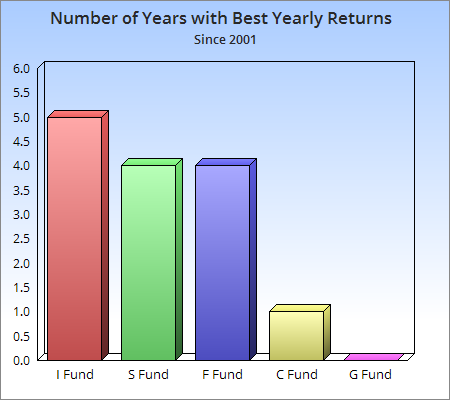
Almost every year, a few TSPCenter participants have outstanding returns. Sometimes they beat all the TSP funds by a large margin. This brings up a question: how likely are they to repeat this?
FantasyTSP study
This prompted us to do some research. Starting in 2008, we found participants with the top five annual returns. Then we looked at their performance the following year. Could they beat a passive allocation with 20% in each of the C, F, G, S and I Funds?
A great year is very difficult to repeat
The answer was a clear “not likely.” 79% of the time, the top 5 couldn’t beat the passive allocation in the following year.
What’s the alternative?
If chasing short-term performance isn’t the answer, then what is? Should you follow the buy-and-hold crowd? Absolutely not. You don’t have to sit through long, crushing bear markets with the buy-and-holders. Nor do you have to follow the trader with the best 4-month track record. There’s another way.
In the next few posts, we’ll explain more about our approach. For now, remember this: short-term performance is noise. Nothing more, nothing less. To steadily beat the market while taking less risk, you need two things. First, a way to handle falling markets. Next, the ability to align yourself with the market’s trends.